
What is the relationship we need between self-organised, bottom-up, self-chosen people’s assemblies and sortition- or lottery-based assemblies that demographically reflect the wider public?
Held by Professor Graham Smith and Clare Farrell, facilitated by David Bent.
- You can watch the summary video of the round-table:
- Watch “setting the problem definition”, between Graham and Clare Farrell
- Or watch the entire dialogue
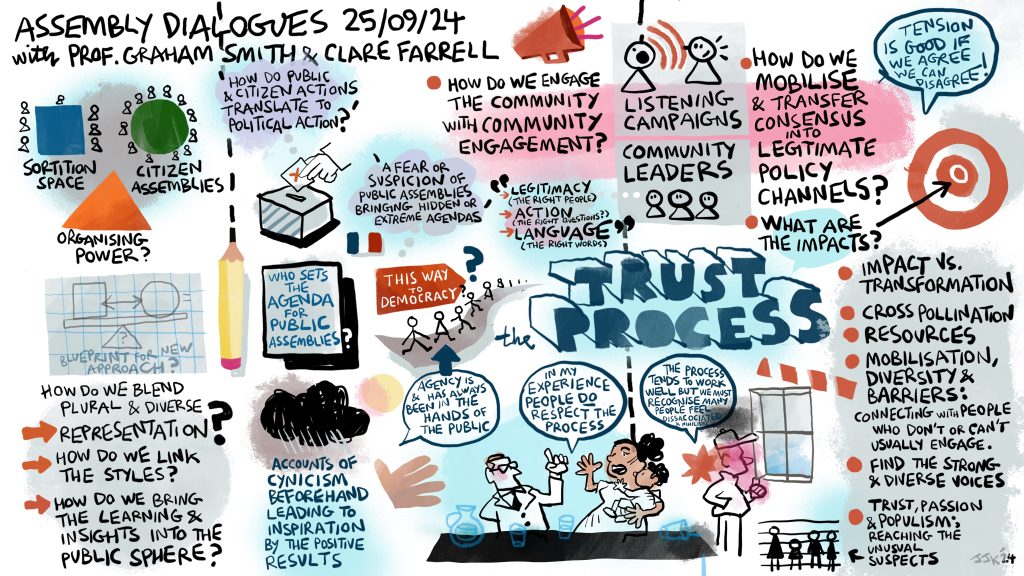
- And wonder at Josh Knowles‘ live illustration from the round-table:
Context
Right now a lot of people, groups and social movements are using a grassroots, self-built model of people’s assemblies as a space of welcome, of listening and of making decisions together, to work out what their community needs to do next.
Aspirationally, they’re also often pointing these self-selected assembles as contributing to or leading to new sortition- or lottery-based assemblies (often called Citizens’ Assemblies) as part of an upgrade, reform, evolution or revolution in our existing governance structures – for example, the campaign to replace of the House of Lords with a House of Citizens. These sortition or lottery-based assemblies are not self-selected; they are assemblies to which people are invited to create a representative picture (in terms of age, ethnicity, gender, and other factors) of the wider public, to reach outcomes of collective judgement and public wisdom.
The question, then, is what could the relationship be between the two models? How do they or should they relate? There are various options: the people’s assemblies come up with agenda items the sortition assembly then looks at; and indeed, the sortition assembly can set the agenda for discussion at the people’s assemblies. When something comes out of the sortition assembly, someone has to act on those recommendations! And that might not be – often won’t be – the government of the day. So does it need to be different bodies, such as the people’s assemblies, social movements, or other civic organisations who consider how those outcomes are going to be followed through, or even enact the decisions themselves.
One issue could be that people who are active in the people’s assemblies feel a right to be involved in the sorition assembly, or to have access to the process directly. But the sortition assembly, especially a Citizens’ Assembly, is separate, and, for those working in the academic field of democratic renewal at least, that difference needs to be respected. But there’s no reason they can’t interact, or co-exist in a positive way, and that’s the exciting agenda.
So the question for this dialogue is: what is the relationship between these forms of assembly, and how can we make this relationship interesting, self-reinforcing, generative and productive? We must recognise and celebrate their differences. And sometimes these may come into conflict. But any parts of an institutional system always come into conflict. That is normal. There is no perfect blueprint to this. We’re going to work through it and see what we can come up with.